Guide
White villages near Málaga: which to visit, how to get there and when to go
Frigiliana, Mijas, Casares, Ronda, Cómpeta and blue Júzcar: facts, festival dates and how to reach them from the coast. With directory listings.
In short
The province of Málaga has white villages on the coast and in the mountains. Frigiliana and Cómpeta are in the Axarquía, Mijas and Casares look out to sea from the Costa del Sol, and Ronda and Júzcar lie in the sierra. With a car you can see two in a day; without one, Ronda and the Axarquía have organised trips or buses.
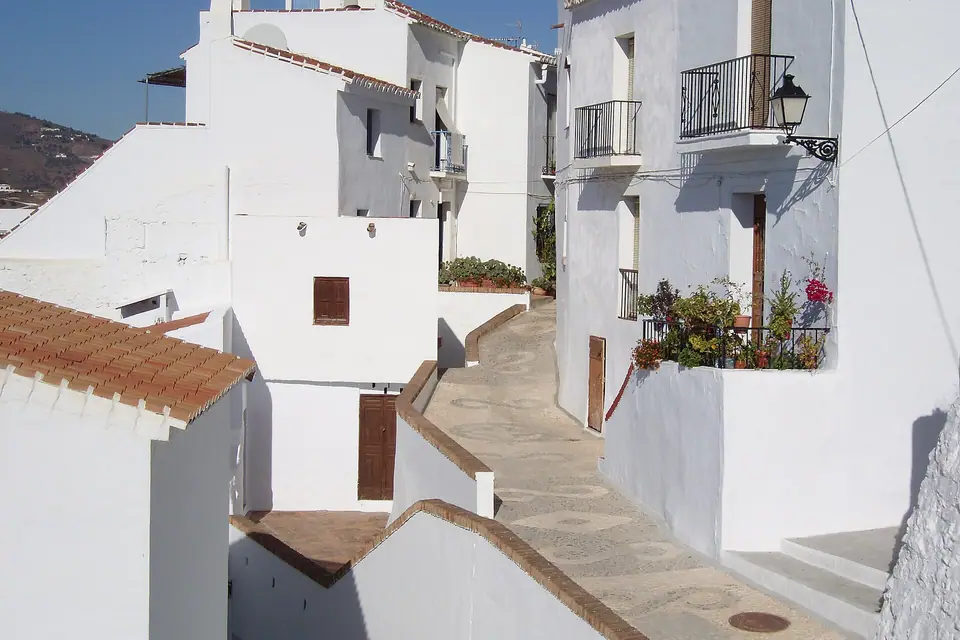
White villages are the other side of the Costa del Sol: whitewashed houses, steep lanes and small squares anywhere from half an hour to a couple of hours from the beach, depending on which you pick. The province of Málaga has plenty; here are six we can document, plus a hop to Setenil de las Bodegas, just over the border in Cádiz.
Population, altitude and dates come from public sources cited on each village page in the directory. Festival dates change from year to year and so do transport timetables, so check before you go.
Frigiliana and Cómpeta: the white villages of the Axarquía
Frigiliana has 3,383 inhabitants (INE 2025) and stands at 300–320 m. Christian troops destroyed its Arab castle in 1569, in one of the last actions of the Morisco uprising, and twelve ceramic panels placed in 1982 tell that story in the Morisco quarter. In 2015 it became the first municipality in the province accredited as one of Spain’s Most Beautiful Villages. Look out too for the fountain on Calle del Inquisidor, with its cross, crescent and star of David.
Cómpeta stands at 638 m, has 3,824 inhabitants (INE 2025) and is 51.5 km from Málaga city, according to Wikipedia. This is muscat-grape country, and its Noche del Vino takes place on 15 August with a tasting of local wine.
To see Frigiliana without driving, the directory lists the eight-hour day trip to Nerja and Frigiliana from Málaga; the operator advertises a small-group transfer, but its description does not say which tickets are included, so check on its website. If wine interests you, close to Cómpeta, in Sayalonga, there is a visit with tasting and lunch at Bodegas Bentomiz (from €59, according to a wine-tourism portal).
Mijas Pueblo and Casares, looking down on the coast
Mijas Pueblo stands at 428 m and was declared a historic-artistic site in 1969. Its patron, the Virgen de la Peña, has a hermitage carved into the rock by a Carmelite brother between 1656 and 1682, and the donkey taxis have run since the late 1950s. Stroll the Jardines de la Muralla, over the remains of the fortress, to a lookout with sea views. In June there is the Villa de Mijas theatre festival and a flamenco festival at the auditorium.
Casares stands at 435 m and has 9,009 inhabitants (INE 2025). Its castle dates from the 13th century and Blas Infante was born here in 1885; his birthplace is among the places of interest. The Roman baths of La Hedionda, from the 1st century, lie out in the countryside, apart from the village. The August fair is on the first weekend of the month, and in July there is a medieval market.
Both villages are easy to combine with the coast, but the directory does not yet list an excursion centred on them: the practical way is a car or the local bus. Check timetables with the operator.
Ronda and Setenil: the big white town of the sierra
Ronda stands at 723 m, has 33,671 inhabitants (INE 2025) and is about 100 km from Málaga city. The Puente Nuevo and the bullring are 18th-century works by Martín de Aldehuela; it is about 100 m down from the bridge to the Guadalevín river. The Arab baths were built in the late 13th century. See the bridge from below and from above.
The directory has the bullring and its museum (€10 general, €12 with audio guide per the official site), the Arab Baths (€4.50), the Casa del Rey Moro, the Palacio de Mondragón, two wineries with tastings, a hot-air balloon flight with breakfast (€205) and the Tajo via ferrata (€40). The bullring’s official website warns of consolidation works in progress, so check before you go.
From Ronda you can carry on to Setenil de las Bodegas, already in the province of Cádiz, with 2,634 inhabitants (INE 2025) and houses built as shelters under the rock overhangs, in the gorge of the Guadalporcún river. We give no distance or time from Ronda because we have not confirmed one in a reliable source.
Júzcar, the blue village of the Genal Valley
Júzcar lies in the Genal Valley, in the Serranía de Ronda, about 25 km from Ronda. It has 208 inhabitants (INE 2025) and stands at about 623 m. In June 2011 the film The Smurfs premiered there and the houses were painted blue; in December 2011 the villagers voted to keep the blue rather than go back to traditional white. Today it is known as the Blue Village (La Aldea Azul).
The directory has no organised excursion that stops at Júzcar. The most practical way is to combine it with Ronda by car; take care, as these are mountain roads, and check the route first.
Getting there from the coast and when to go
By car, Ronda connects with the Costa del Sol along the A-397 to San Pedro Alcántara, and via the A-367 and A-366 towards the Guadalhorce valley and the Sierra de las Nieves. Without a car, there are CTSA-Portillo buses to Ronda from Málaga, Fuengirola, Marbella and Torremolinos and, according to Wikipedia, one daily train to Málaga that returns in the afternoon. Confirm days and times with the operator or Renfe, as they change.
For the Axarquía, the directory’s no-driving option is the trip to Nerja and Frigiliana. For Mijas, Casares and Júzcar you will need a car or the local bus.
As for when to go: event dates are in the next section, but any time of year works day to day. The mountain villages stand higher than the coast (Ronda at 723 m), so winter can be cooler.
Festivals with dates
Frigiliana: Festival Frigiliana 3 Culturas, 27–30 August in 2026. Ronda: Feria de Pedro Romero, 1–6 September in 2026, with the Corrida Goyesca on Saturday 5th; book ahead. Cómpeta: Noche del Vino on 15 August and Cruces de Mayo on 3 May. Casares: August fair on the first weekend of the month. Mijas: theatre and flamenco festivals in June.
The 2026 dates are those recorded in local sources and the press; other years may differ, so confirm with the town hall.
Frequently asked questions
Which white villages near Málaga are most worth visiting?
It depends on the area. In the Axarquía, Frigiliana and Cómpeta; on the Costa del Sol, Mijas and Casares; in the sierra, Ronda and Júzcar. Ronda is the largest and has the most visits listed in the directory.
Why is Júzcar blue?
The houses were painted blue in 2011 for the premiere of the film The Smurfs. In December that year the villagers voted to keep the blue.
Can you go without a car?
To Ronda yes, by bus or on the daily train according to Wikipedia, and to Frigiliana with the eight-hour trip from Málaga. For Júzcar, Casares and Cómpeta a car is the most practical. Check timetables.
Is Setenil de las Bodegas in Málaga?
No, it is in the province of Cádiz, but it is usually visited from Ronda.
Atlas de Málaga editorial team · reviewed on 21 November 2026
More guides
- Caminito del Rey tickets: price, how to get there from Málaga, how long it takes and what to bring
- Day trips from Málaga: the Alhambra, Ronda, Caminito del Rey, Seville, Gibraltar and Tangier
- Málaga in winter: real weather data, what is open and what to do from November to March
- Things to do in Málaga: 14 places in the city and the province, by area
- Málaga in the rain: things to do
- Málaga with kids: what to do
- Málaga for little or nothing
- Low-effort, relaxed plans in Málaga